
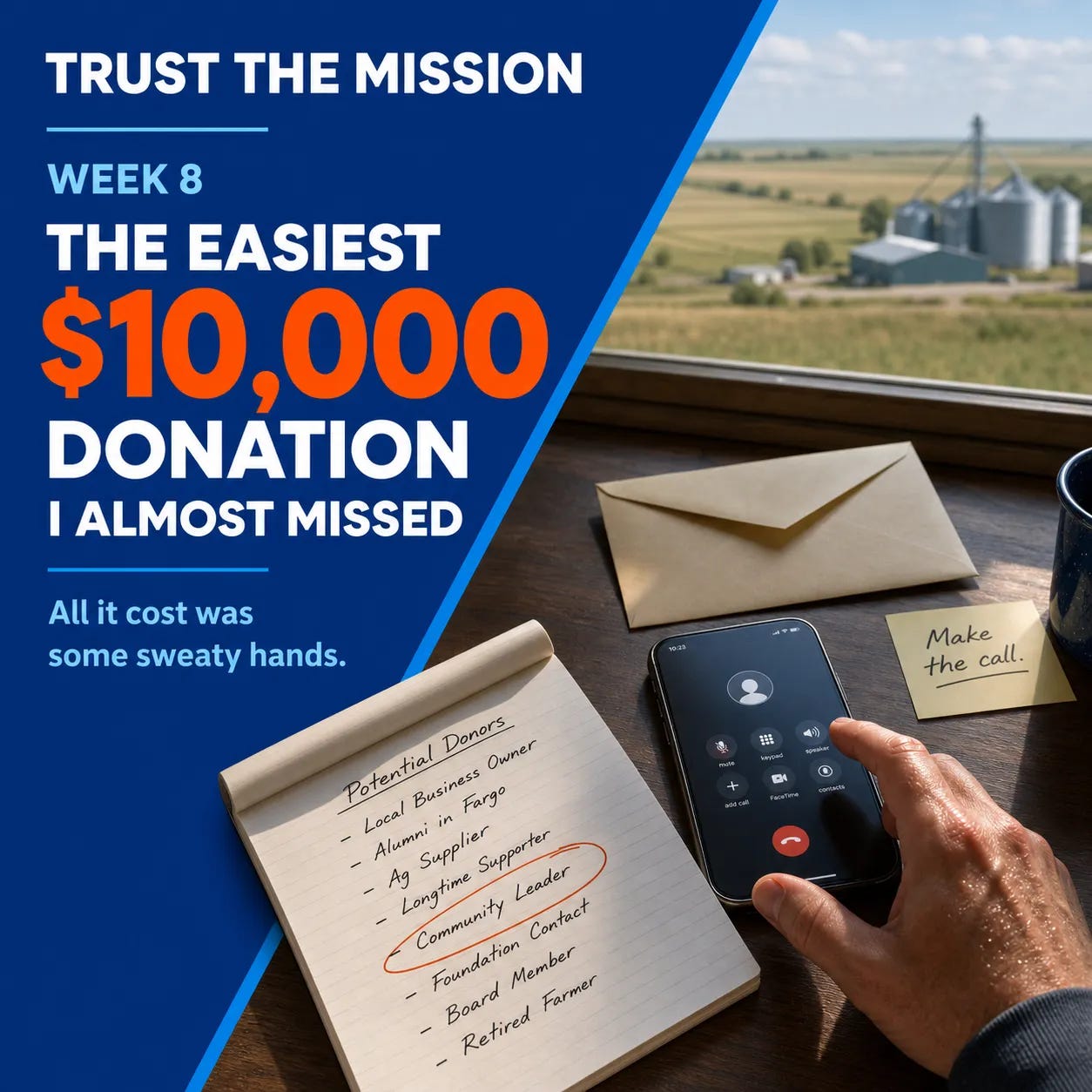
The Easiest $10,000 Donation I Almost Missed
All it cost was some sweaty hands.

While raising money for a Christian homeless shelter in Grand Forks, North Dakota, I met a donor named Bill I hadn’t talked to in eighteen months. Bill and his family ran a potato operation outside town. They’d given over $10,000 a year to our work with people experiencing homelessness.
I knew I needed to reconnect.
I told myself that for weeks — and didn’t do it.
I talked myself out of it, over and over. Too much time had passed, I reasoned. Showing up now to ask for a gift would feel presumptuous. I could have called. Instead, I decided I needed to see Bill in person — one more excuse to stall.
Finally, I drove out. Palms sweating, I walked up to the door of his processing plant, rehearsing what I’d say. I found Bill and thanked him for his past generosity. Later, I mentioned it had been almost a year and a half since we’d talked. He looked genuinely surprised — he thought they were still giving. He surprised my by handed me a check for $10,000. Years ago, while raising money for a Christian homeless shelter in Grand Forks, North Dakota, I met a donor named Bill I hadn’t talked to in eighteen months. Bill and his family ran a potato operation outside town. They’d given over $10,000 a year to our work with people experiencing homelessness. I knew I needed to reconnect. I told myself that for weeks — and didn’t do it.
I talked myself out of it, over and over. Too much time had passed, I reasoned. Showing up now to ask for a gift would feel presumptuous. I could have called. Instead, I decided I needed to see Bill in person — one more excuse to stall.
Finally, I drove out. Palms sweating, I walked up to the door of his processing plant, rehearsing what I’d say. I found Bill and mentioned it had been almost a year and a half since we’d talked. He looked genuinely surprised — he thought they were still giving. Before I left, he handed me a check for $10,000.
I almost missed his generosity
Relief is too calm a word for what I felt. It was sheer joy.
Feeling brave, I called another donor, Mike, that same week. What he said back has stayed with me for years: “Dave, I was praying about who to send $7,500 to. You are an answer to prayer.”
Relief is too calm a word for what I felt. It was closer to joy.
Feeling brave, I called another donor, Mike, that same week. What he said back has stayed with me for years: “Dave, I was praying about who to send $7,500 to. You are an answer to prayer.”
Weeks of avoidance. Two gifts, both waiting on the other side of a fear that had nothing to do with the donors and everything to do with what was going on in my head.
If you’ve lived some version of this — stalling, rehearsing, finding one more reason to wait — you’re not bad at fundraising. You just never trained for this part, and you’re doing it scared.
What you’re actually afraid of
The fear of asking is rarely about the money. Most ministry leaders can talk for an hour about their program’s impact without hesitating once. Put a dollar figure and a person’s name in the same sentence, though, and something locks up.
We are taught not to talk about money. It is disrespectful or nosy to have conversations about people’s finances. So many Christian leaders get stuck in their own brains instead of letting the donor guide the discussion.
I can almost always hear them ask the same questions in their mind:
Will they say yes? Will they see this as greedy, asking again so soon? Am I doing this for the right reasons, or to keep the program funded and my paycheck coming?
I’ve sat across the table from dozens of ministry leaders stuck at exactly this point, staring at a number that feels too big to say out loud. Almost always, they’re comparing their bank account to their donor’s. We assume donors see money the way we do — scarce, guarded, a big deal to give away.
It’s rarely true. Generous people have more reasons and more ways to give than you’d guess. Money means something different to them than it does to you. Stop putting donors in a box. You don’t actually know what a gift will cost someone until you ask.
Write this on a sticky note:
The ask is not about you. It is about the donor’s opportunity to be generous.
Think of the Trust Bridge — awareness, belief, trust, partnership. If you’ve done the work of the earlier weeks in this series — real stories, real outcomes, people treated like people instead of prospects — the donor is already standing at the threshold by the time you get to the ask. They already believe. They’re already trusting you with their attention, maybe their prayers, maybe their name on your list.
The ask doesn’t introduce a transaction into the relationship. It opens a door that’s already half-open and says, “Here’s how you walk through.”
A donor who’s followed your work, prayed for your program, told their spouse about the family you helped last spring — isn’t waiting to be left alone. They’re waiting to be invited. Your silence doesn’t protect them.
It just leaves them standing at a door nobody opened.
What to actually do this week
Reframing helps. It won’t send the email on its own. Here’s what will:
Call it an invitation, not an ask — even just in your head. Before you write or say anything: I’m inviting someone into work they already care about. Small shift. It changes your tone on the call.
Be Memorable.
Thank the donor: And share how they have impacted your program in the past: “Thank you for your gift that helped Stacy and her kids find a new home.”
Be specific when you ask: “We are currently $8,000 short of covering the tutors for next semester.”
Share with them a concrete next step: Then, specify the next step: “Would you consider making a gift of $500 this month?” A vague request results in uncertainty, while a specific one leads to a interaction between trusted friends.
Make the smallest ask first. Don’t wait for the six-figure conversation to practice courage. Send one email today to one donor for one modest thing. Size matters less than the fact that you did it.
Decide in advance what “no” means. It’s not a verdict on your worth, your program, or your calling — it’s information about timing. No is just the first few letters of “not yet.” Not at this time.
Debrief every ask, win or lose. What did you notice? What would you change? It’s a skill you’re building, not a test you’re passing or failing.
Rehearse with one person — a board member, a spouse, a fellow leader. Say the ask out loud before you say it to the donor. The number gets less terrifying every time you hear yourself say it.
None of this makes the ask comfortable. It makes it possible. That’s a fair trade.
What Scripture already knew about this
Nehemiah wanted to rebuild the wall around Jerusalem. He had no resources of his own — the wood, the funding, the permission belonged to a foreign king who held his life in his hands. Scripture says he was “very much afraid” before he asked (Nehemiah 2:2). He prayed first. Then he asked anyway — specifically, naming exactly what he needed and from whom.
The wall got built because a frightened man asked a hard question out loud.
I think of that every time I remember what Mike told me. I hadn’t set out to be anyone’s answer to anything — I’d just made the call I’d been avoiding.
That’s often how it works. Someone’s already praying about what to do with a gift. Your ask is what connects their obedience to your need.
Stewardship isn’t just what you do with money once it arrives. It’s whether you were willing to ask for it in the first place, on behalf of people who are counting on you to.
The door is still open.
Somewhere right now, a donor who believes in what you do is waiting — not to be left alone, but to be given a way in. Every ask you’re avoiding is a door someone else wants to walk through.
You’re not asking them to fund a budget line.
You’re asking them to say yes to something God is already doing.
And you might be the answer to somebody’s prayer, the way I turned out to be Mike’s.
Send the email. Make the call. Sit across the table and say the number. The mission was never funded by leaders who felt ready. It was funded by leaders who were afraid and asked anyway.
What’s the ask you’ve been avoiding? Hit reply and tell me. Sometimes the fastest way through the fear is saying it out loud to someone else first.
Dave Sena is the founder of Bold Leading, where he works with faith-based nonprofit leaders on fundraising strategy and donor relationships that sustain meaningful mission work.