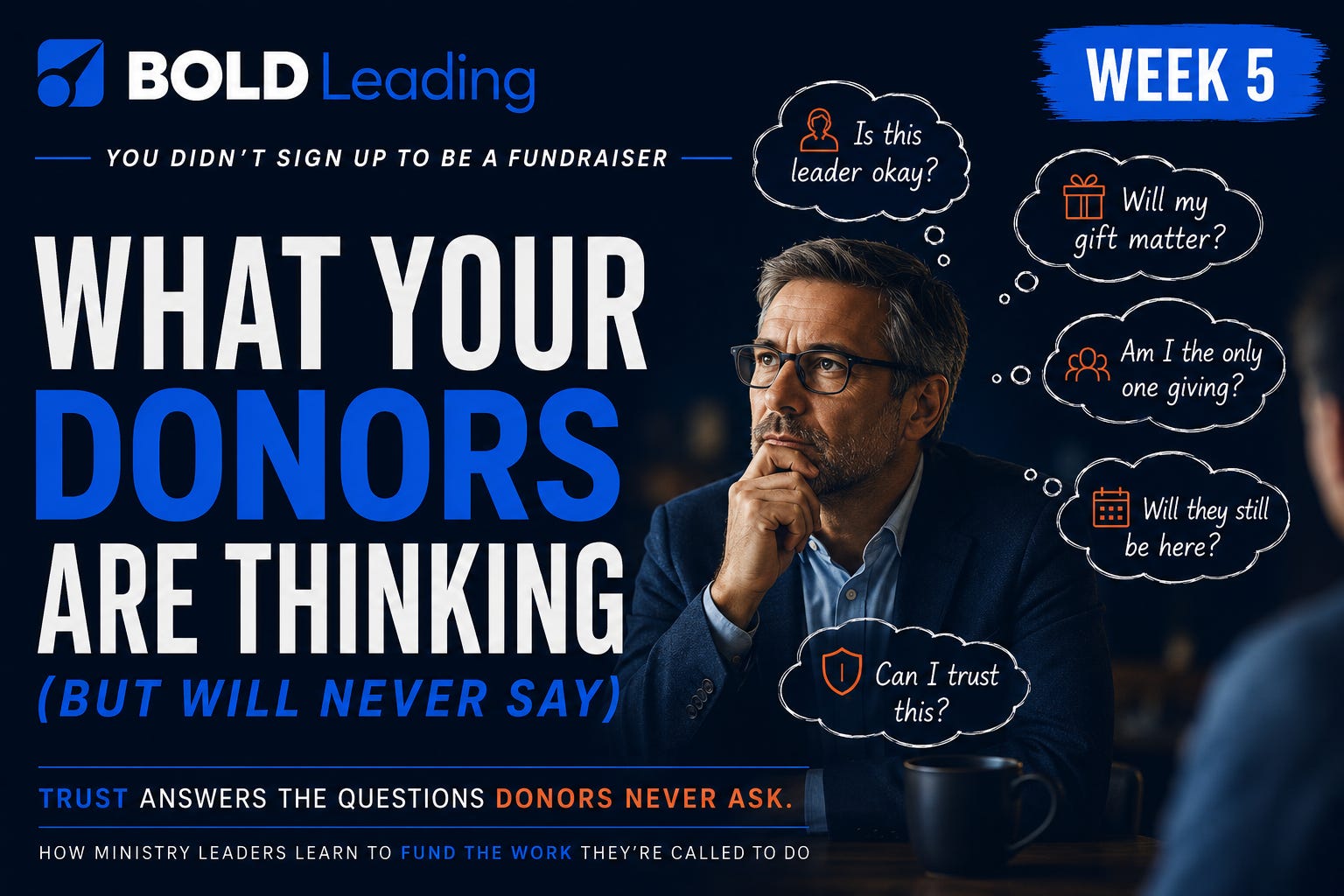
What Your Donors Are Thinking (But Will Never Say)
Trust Funds the Mission | Week 5 of 12
Dan and his wife gave to our events every year through sponsorships. Reliable. Consistent. I assumed he was happy.
One morning at breakfast, I asked him something I’d never asked before: Does giving this way actually satisfy you?
I expected a yes.
He said no.
So I asked what he’d prefer. He said: What if we met a few times a year, you told me what the mission actually needed, and maybe I funded that?
Dan became one of our largest donors. He funded studies. He invested in the work itself. All because someone asked one question and got quiet enough to hear the answer.
Here’s what I’ve learned since: Dan was carrying a question for years that he never said out loud. And almost every donor on your list is doing the same thing right now.
The Questions That Stay Silent
Donors rarely say what they’re wondering. They won’t push back. They’ll give you every signal the meeting went well — and walk away uncommitted.
Not because they’re dishonest. Because they’re human. The questions that matter most stay silent, and if you want to be responsive instead of just polished, you have to learn to hear what isn’t being said.
There are five of them.
1. “Is this leader actually okay?”
Donors are observant — many have spent careers reading people. They notice exhaustion. They sense anxiety. They can tell when someone is running a program they love while carrying more than they should.
You don’t have to pretend everything is fine. Donors don’t need fine. They are aware that things are not perfect — they’ve spent their working careers in the trenches too.
Name what’s hard, then name your plan to get through it. There’s a confidence that comes from telling a donor here’s the barrier in front of us, and here’s how we’re working through it. That’s not weakness; it’s command of the situation.
You’re not asking donors to fly the plane over your problems. You’re inviting them to join the journey through the barriers. When they see that you’ve already mapped the way forward, they don’t see someone drowning — they see someone committed and resilient enough to be worth backing.
2. “Will my gift actually matter?”
They won’t ask, because they don’t want to sound cynical. But they’ve given before and felt nothing — no proof, no story, no line connecting their check to any outcome.
The story isn’t decoration. It’s the answer. One recent, specific story. Not an aggregate. One person. Something real.
3. “Am I the only one giving?”
Donors don’t want to be the lone believer. If they sense the organization runs on one or two relationships, it stops feeling like a movement and starts feeling like a dependency.
You don’t need a massive base to answer this. You need evidence of breadth — a recent new donor, a growing list, a community of givers. That signals their trust isn’t a solo bet.
4. “Will this leader still be here in two years?”
This one is personal in a way the others aren’t. Donors give to people, and people leave — they burn out, pivot, move on. A donor who’s lived through that carries the scar.
You can’t promise you’ll never change course. But you can show durability — through consistency, through how you talk about the long game. The leader who describes the mission ten years out as if they’ll still be in it answers this question without ever raising it.
5. “Can I trust what I’m being told?”
Not is this person untruthful. Something deeper. They want the raw truth. Are these impact numbers measured, or just hoped for? Does what I’m hearing in this room match what’s happening on the ground?
Show your work. Share the real numbers. Actual learnings. When you say here’s what we tried, here’s what it taught us, here’s what we changed — you let a donor behind the curtain of your commitment to change lives. They’re not just hearing the polished outcome; they’re watching you do the work and improve at it.
That kind of honesty is rarer than donors expect. And they notice it immediately.
The Shift
Stop preparing around what do I need to communicate. Start preparing for the question this person is most likely carrying.
A first-time prospect is usually wrestling with question five. A longtime supporter who’s gone quiet is probably at question two. A foundation officer is almost certainly on question three.
When you know which question is live, you shape the whole conversation to answer it — not by addressing it head-on, but by telling the right story and showing up the right way. Donors give when they’ve resolved something internally — when trust tips into action.
This is exactly what Dan was waiting for. He’d been quietly stuck on question two for years. Not a better pitch — a better question.
Why Most Fundraising Never Gets Here
Here’s the hard part. Reading donors this way isn’t a talent you either have or don’t. It’s a system — a repeatable way of knowing who’s carrying which question, and building the conversations that answer it before you ever make the ask.
Most organizations don’t have a repeatable, learnable method. They have a calendar of asks and a spreadsheet of hopes. Every donor meeting starts from zero. Every relationship lives in one person’s head. And when that person leaves, the giving walks out the door with them.
This is the work I do with executive directors. I call it the Connected Fundraising Framework — a structure that turns scattered donor relationships into a repeatable engine: which question each donor is carrying, what conversation answers it, and how to move them from awareness to partnership. It gets the system out of one person’s head and into the organization — down to the mechanics of how you prepare for a meeting, what you put in front of a donor, and how you follow up so nothing falls through.
It’s the difference between hoping your donors trust you and building the conditions where they actually do.
You already know how to read people. You’ve done it for years — in program work, in pastoral conversations, in volunteer relationships. That attentiveness isn’t separate from fundraising. It is fundraising. The Framework just gives it a structure so it scales past you.
The Faith Piece
Proverbs 20:5 — “The purposes of a person’s heart are deep waters, but one who has insight draws them out.”
Not a fundraising verse — a description of what good relationship work looks like. Insight that draws out — the opposite of manipulation. Understanding what someone is carrying, and creating the conditions where they can think clearly, feel safe, and decide from their own values.
When you meet with a donor, they want to know what’s in your heart. And they’ll often reciprocate — sharing their own purpose in giving. When two people partner in a way that honors shared values, trust wins. Your mission moves forward. Lives are changed.
Start Here
Schedule a meeting this week with a donor you haven’t seen in a while. Before you go, ask yourself one question: What is this person wondering that they haven’t said? If you’re unsure, pick two of the five and aim to answer those. Then listen and adjust. People would rather you be authentic and awkward than polished and performative.
That’s how trust funds the mission.
If you’re tired of every donor relationship depending on you personally — and you want a system that makes Connected Fundraising repeatable across your whole organization — that’s exactly what I help executive directors build. Book a 20-minute discovery call, and I’ll show you what it looks like in an org like yours.
P.S. — Want a taste of how the Framework works in practice? The Two Folder System is the exact setup my major gift officers use to walk into a donor meeting prepared and walk out with a clear next step — what to put in the donor’s hands, and what to keep for your own follow-up. It’s the simplest piece of Connected Fundraising you can put to work this week.
Dave Sena is the founder of Bold Leading, where he helps faith-based nonprofit leaders install the fundraising systems and donor relationships that sustain meaningful mission work. Subscribe to Trust Funds the Mission at blog.boldleading.com.