

People Give to People
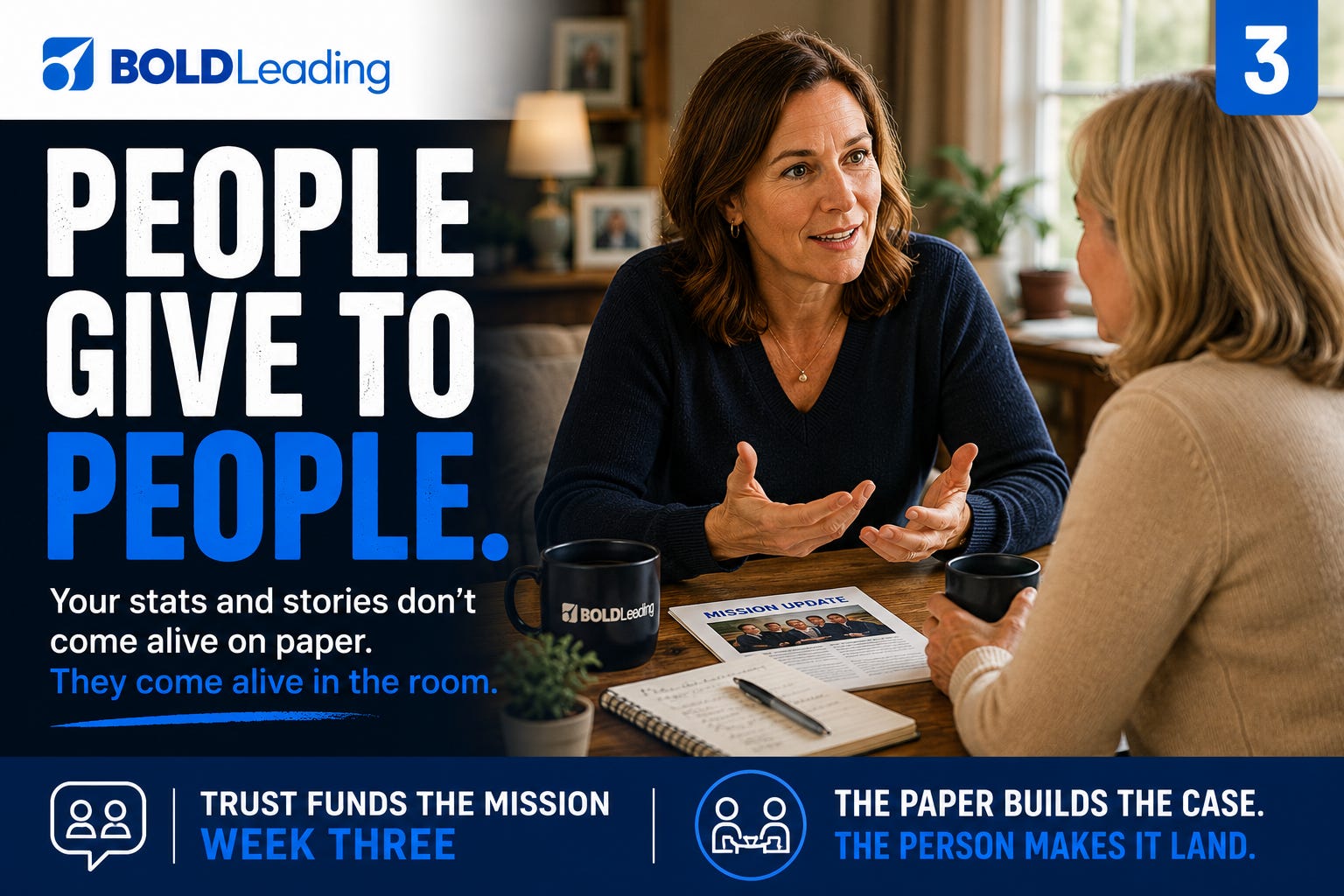
Your stats and stories don't come alive on paper. They come alive in the room.

I’ve been in hundreds of donor homes over my career. And something still amazes me every time.
They invite me in. They’ve supported the mission for years. And then they ask: “So… what exactly do you do over there?”
We’d sent them newsletters. Direct mail. Emails. Thank-you letters—years of it.
And they have basic questions.
Here’s why that’s not a failure — it’s the whole lesson. When I asked what made them give, the answer was rarely our outcomes.
“My parents always supported this kind of work.”
“I just believe in what you do.”
“I don’t know all the details, but I trust it matters.”
They didn’t give to information. They gave to belief — and to a person who showed up.
The questions they only ask in person
Some donors do want everything: the stories, the stats, the outcomes. And we give it to them gladly.
But here’s what struck me sitting in those living rooms: the questions they asked me face-to-face were never the questions we answered in our mailings.
“Where do you get your food?”
“How’s the economy hitting your costs?”
“How late can someone stay out before they have to be in for the night?”
You can’t merge-field your way to that conversation.
No newsletter prompts it.
Those are the questions of a person leaning in — testing not just the program, but the people running it. And every honest answer built a little more trust.
That’s the moment the gift gets deeper. Not when donors scan the report. When they look you in the eye, and you tell them the truth.
Not integrated Fundraising. It’s Connected Fundraising.
Don’t hear me wrong — stats, stories, and outcomes are essential. We do the hard work of capturing the good we do and putting it on paper. That work matters.
But donors want to hear those stats and stories from someone they trust. The same outcome lands differently when it comes from a person who looked them in the eye than when it comes from a newsletter they half-skimmed.
And here’s the part most leaders miss.
When I sit down with a donor, I’m not replacing the mail. I’m helping them open it.
In conversation, that last newsletter they didn’t quite absorb suddenly makes sense. The numbers get a face. The story gets a voice. And the next piece of mail? They’ll actually open it — because it’s from someone they sat with a few weeks ago.
That’s not integration. Integration is channels working together. Being connected is something deeper:
Connected Fundraising — where a real human relationship anchors every letter, email, and report. The channels don’t just coordinate. They connect through a person.
What a privilege it is to help someone open our mail in person. To turn a one-way message into a dialogue. The paper builds the case. The person makes it land.
The human keeps disappearing.
Your org grows. You get a database. Automation. A CRM that promises to “nurture donor relationships at scale.”
And slowly, without anyone deciding it, the human vanishes.
The thank-you becomes a receipt.
The update becomes a blast.
The ask becomes a template with a name dropped in a merge field.
We call it efficient. It’s actually forgettable.
No dashboard will tell you this: people don’t bond with systems. They bond with people.
So here’s the principle the whole series turns on:
People give to people.
Not to logos. Not to brochures. To a human they believe in, doing work they believe matters. The cause makes them curious. The person earns the gift.
Warmth is not unprofessional.
Somewhere we got trained to think “professional” means polished, neutral, corporate. So we sand the personality off our writing until we sound like every other org asking for money.
Then we wonder why donors don’t feel connected.
Hear this plainly: warmth is not a liability. It’s the whole point. The slightly imperfect, clearly human voice out-raises the corporate one nearly every time.
Think about your own giving. You don’t give to the slickest video. You give to your friend running the marathon. The family from church. The leader who looked you in the eye and told you the truth.
Proximity to a real person is what moves you. Your donors are no different.
Three moves for Monday morning
You don’t burn the systems down. You warm them up.
1. Sign things like a person. Read your last appeal out loud. If a sentence would sound strange across a kitchen table, rewrite it. Most of all, write in the first person. Watch what “I” does:
“The mission served 1,200 meals last month.”
“I watched a man eat his first hot meal in three days last week.”
Same work. Completely different letter. The first informs. The second puts a person in the room. You wouldn’t sit in a donor’s living room and say “the mission is grateful” — you’d say “thank you, this means the world to me.” Write the way you’d talk. Just don’t make it about you: the “I” is a witness, not the hero. It’s “I saw what your gift did,” never “I worked so hard this year.”
2. Connect the paper to a person. Your newsletters and appeals aren’t doing the work on their own. Get in one room — a visit, a coffee, a tour — and let the donor ask about what you’ve already sent. You’re not replacing the mail. You’re helping them open it. The next piece they receive lands differently because it’s now from someone they know.
3. Put a face on the work — including yours. Tell donors why you do this, not just what the org does. They’re not funding a program. They’re believing in a person. Give them one worth believing in.
None of this scales cleanly. That’s the point. What builds the deepest trust rarely does.
A word for the faithful
Paul described his ministry this way:
“We were ready to share with you not only the gospel of God but also our own selves, because you had become very dear to us.” (1 Thessalonians 2:8)
Our own selves. Not just the message — the person carrying it.
We follow a God who didn’t save us through a system or a mass mailing. He came in person. The whole faith is relational — a God who draws near and knows our names.
Lead your donor relationships the same way.
You’re not a fundraising machine. You’re a person, inviting people into something that matters. Lead like it.
Your challenge this week
Get in one room you’d normally handle by email: a visit, a call, a coffee. Then stop pitching and let donors ask the unanswered questions.
You’ll be amazed what they want to know — and how much trust grows in the answering.
People give to people. Build the relationship, and the support follows.
If this resonated, subscribe—I write weekly for leaders carrying both mission and money. Reply with one line: what’s the best question a donor ever asked you in person?
Dave Sena has spent nearly 30 years in the nonprofit trenches — leading rescue mission turnarounds, sitting in hundreds of donor living rooms, and carrying the quiet weight of mission work that has to be funded. He’s the founder of Bold Leading, where he helps faith-based nonprofit leaders build donor trust, raise support faithfully, and lead without burning out. He believes the mission isn’t funded because people understand the need — it’s funded because they trust the leaders carrying it.