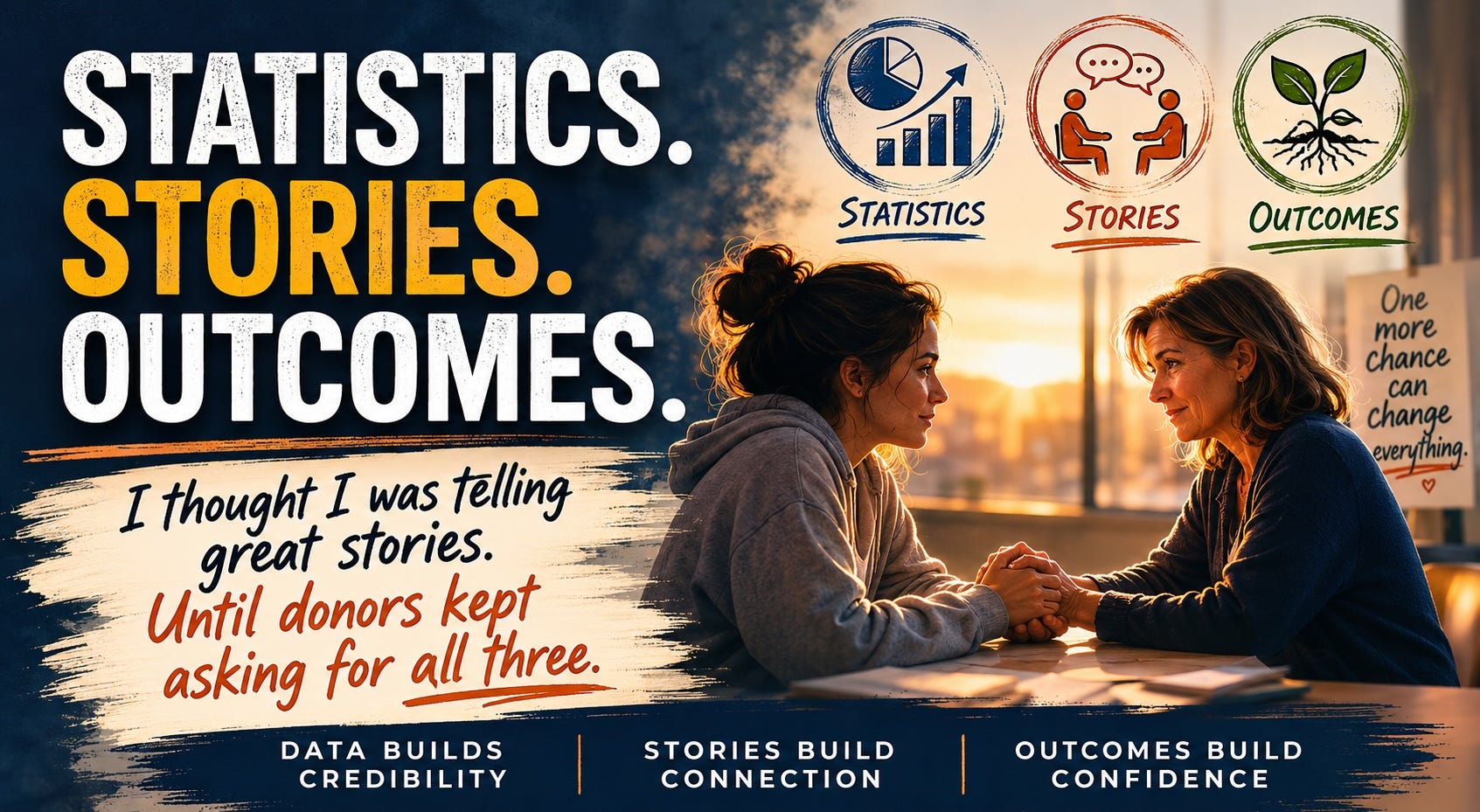
Statistics. Stories. Outcomes.
I thought I was telling great stories. Until donors kept asking for all three.
When I was an executive director of a Christian homeless shelter, I was talking with my assistant director in the administration office, deciding whether to give someone one more chance.
She had been in the shelter program for months. Severe mental health challenges. Erratic behavior. Repeated rule violations. Fights with other residents. We had extended grace before. Multiple times. And here we were again — tired, stretched, running out of answers — asking the same hard question.
Do we keep trying?
What happened next is the kind of thing that doesn’t show up in a program report.
Tracy — not her real name, but her real story — walked into that room and challenged us to try again. She looked us dead in the eye.
“You did not give up on me,” she said. “Don’t give up on them. It can work.”
We decided yes — one more time.
Tracy knew. Because Tracy had been that person once. She came to the shelter estranged from her family, struggling with severe mental health issues, one bad decision away from being asked to leave herself. She stayed. The staff kept showing up. Something shifted. Then something held.
Tracy eventually moved into her own apartment. She rebuilt her relationship with her family. And on the day we needed someone to remind us why the work matters, Tracy was there.
Does the work hold? Ask Tracy.
Is the investment worth it? Tracy thought she wasn’t. We disagreed.
She proved us right.
Does the transformation last? Tracy is now in the room fighting for the next person.
That is a story that makes statistics come to life.
Most organizations have a Tracy. They just haven’t learned to connect her story to everything else a donor needs to believe.
I thought I was telling great stories.
Until donors kept asking for Stats, Stories and Outcomes
What Donors Are Actually Looking For
I work with nonprofit leaders all over the country. When I ask them to tell me who has been changed by their program, something interesting happens.
There is a half-second pause.
Not because they can’t think of anyone. Because everyone in the room just thought of the same person. You can see it on their faces — the shift from program language to memory, from reporting to remembering.
Then they start talking. And for a moment, they stop sounding like a grant application and start sounding like people who believe in something.
That moment is what donor communication needs to feel like — all the time.
But a sophisticated donor — the one writing the bigger checks, the one you’re hoping becomes a legacy partner — is asking a harder question behind the emotion.
How often does this happen?
Is Tracy the exception or the rule?
What does transformation look like for most of the people you serve, not just the best one?
Those questions don’t kill the story. They test it. And if you can’t answer them, your beautiful story floats in the air with nothing underneath it.
Statistics. Stories. Outcomes.
You need all three. And they need each other.
Statistics Create Credibility
Numbers say: We are not guessing. We are measuring. We take this seriously.
In a crowded donor marketplace, the organizations that count, track, and report with discipline communicate something important. It says you’re accountable for caring whether the work actually works.
But the statistics donors need go deeper than headcounts and meal totals.
They want to see patterns.
Who is your program actually helping?
What are the trends over time?
Are outcomes improving, plateauing, or slipping?
Are you seeing new needs emerge that your programming isn’t yet equipped to meet?
Most organizations don’t ask those questions out loud until a funder forces the issue. The ones that do — that build systems to track trends and have honest conversations about what the data is actually saying — communicate with the most confidence. Because they’re not performing certainty, they have it.
They can tell a donor:
Our employment program works best for individuals who’ve been in our residential track for at least 90 days. Below that threshold, retention drops significantly. So we’ve restructured the intake process.
That’s not a failure story. That’s a learning organization. Donors and funders will fund a learning organization all day long.
A report full of numbers without humanity is just a spreadsheet with a stamp on it. Most of them end up in a drawer.
Numbers open the door. They don’t close the deal. But without real numbers — honest numbers, trend numbers, not just the ones that look good — your story is standing on sand.
Three Problems Worth Naming
I’ve seen another pattern across hundreds of client conversations. When I ask leaders to describe the problem their program is trying to fix — for whom and at what cost — most of them slip into what I call grant-speak.
Precise. Measured. Technically accurate.
Bland. Passionless. Not bold.
They describe program names and service categories. They use language designed to satisfy a funder’s rubric. And in doing so, they lose the person on the other side of the letter.
Donald Miller’s StoryBrand framework offers a useful lens. Every organization is actually solving three levels of problems.
The philosophical problem is the moral conviction underneath your mission. No one should sleep outside. People in mental health crisis deserve more than one more chance — they deserve someone who won’t quit. Helping hard people is what gets you out of bed at 5 AM and keeps you there past 9 PM.
Donors feel this, too. When you name it clearly, something in them says yes.
The external problem is the specific, visible problem your organization exists to solve. Housing people experiencing homelessness. Feeding families. Connecting isolated individuals to community. Most nonprofits live here — and only here. They describe the problem. They describe their programs. They stop.
But there’s a third level.
The internal problem is the gap between the need and the solution. We have 47 people on our waitlist and no capacity to serve them without additional support. We have staff doing heroic work with inadequate tools. We have a program that works — and not enough resources to offer it to everyone who needs it.
Donors love to fill the gap.
They want to know how their donation is saving the day.
When you only name the external problem — there are people in our city without homes — the donor feels sad but passive. When you name the internal problem — we need groceries for 100 families by next month — the donor becomes the answer. Their gift is not a transaction. It’s a lifeline.
Most leaders are so close to the internal problem that they forget to name it. They assume donors understand the gap. They don’t. Name it every time.
Outcomes Create Confidence
An outcome is not an activity. An output is not an outcome.
Serving 400 people is an activity. Providing 12,000 bed nights is an output. But the woman who came in estranged from her family, struggling with severe mental health challenges, stayed when she could have been asked to leave — and moved into her own apartment connected to the people who love her.
That’s an outcome.
Here is the framework I give every client. Say it plainly, in plain language, for every person your program serves:
They came to us experiencing ______. They left because ______ was true.
They came to us experiencing homelessness, a mental health crisis, and isolation. They left because the staff refused to give up. The program held. Someone convinced them they were worth the investment.
Outcomes answer the most important silent question every donor is asking: Does my investment make a diffference?
Donors are afraid the work they fund is temporary. That you’re solving the same crisis over and over without making a dent. When you show outcomes — real ones, tracked with rigor and told with honesty — you’re saying: The work is holding. The transformation is real. Your investment is compounding.
Pair that with trend data — our 12-month housing retention rate has improved from 61% to 74% over three years — and you’re not just showing a win. You’re showing a learning organization getting better at what it does.
That’s the difference between a donor who gives once and a donor who gives for decades.
Practical Application
Before your next donor communication — letter, email, newsletter, grant report, major gift presentation — run it through these four questions:
Have I given them something to believe with their head? One number. Not a table of data. The one statistic that most powerfully captures scale, impact, or trend.
Have I given them someone to care about in their heart? One person. Real tension. The moment it almost didn’t work. The donor should see themselves as the reason it did.
Have I named all three problems? Philosophical — why does this matter at the deepest level? External — what specific problem are you solving? Internal — what gap exists right now, and how does the donor close it?
Have I shown what’s working over time — and that we know why? Long-term results. Trend data. Proof the investment holds and that your organization is learning, not just operating.
One More Thing
You can have a great program and a struggling fundraising program at the same time.
The work is real. The results are genuine. But nobody outside the building knows it — because the organization never learned to tell the story in all three dimensions.
Statistics. Stories. Outcomes.
It’s not a formula. It’s a discipline. And it starts not with better writing — it starts with better internal honesty about what you’re doing, who it’s helping, and how well it’s working.
Do that work. Then tell the world.
The mission you’re carrying is worth funding. Make sure your donors hear how their funding is changing lives. It’s more than number, it is stories. And it is more than a story. It is a transformational outcome.
Trust Funds the Mission is a weekly series for faith-based nonprofit leaders who are building sustainable support while facing real leadership pressure. If this resonated, subscribe — and share it with a colleague who needs it.
Dave Sena is the founder of Bold Leading and has spent nearly thirty years inside faith-based nonprofits — leading turnarounds, coaching executives, and building fundraising systems that hold. He writes for leaders who are doing hard work in hard rooms and need more than inspiration. If you’re stuck, burned out, or just need someone to pray with you and help you think clearly — reach out at BoldLeading.com.