Trust Funds the Mission
A rookie mistake taught me what nobody tells you about nonprofit fundraising.
In my first year as an executive director, we hit a financial shortfall.
My team gathered around and asked me the question every leader eventually gets: “What are we going to do?”
I said, “I have no idea.”
It was honest. But honest and helpful aren’t always the same thing.
A staff member pulled me aside privately afterward. She asked me if I actually knew what I was going to do. I told her the truth — I’d figure it out. And pray.
She looked at me and said, “Dave, never say ‘I don’t know’ to your team.”
That was the day I understood: the burden I carried was mine alone.
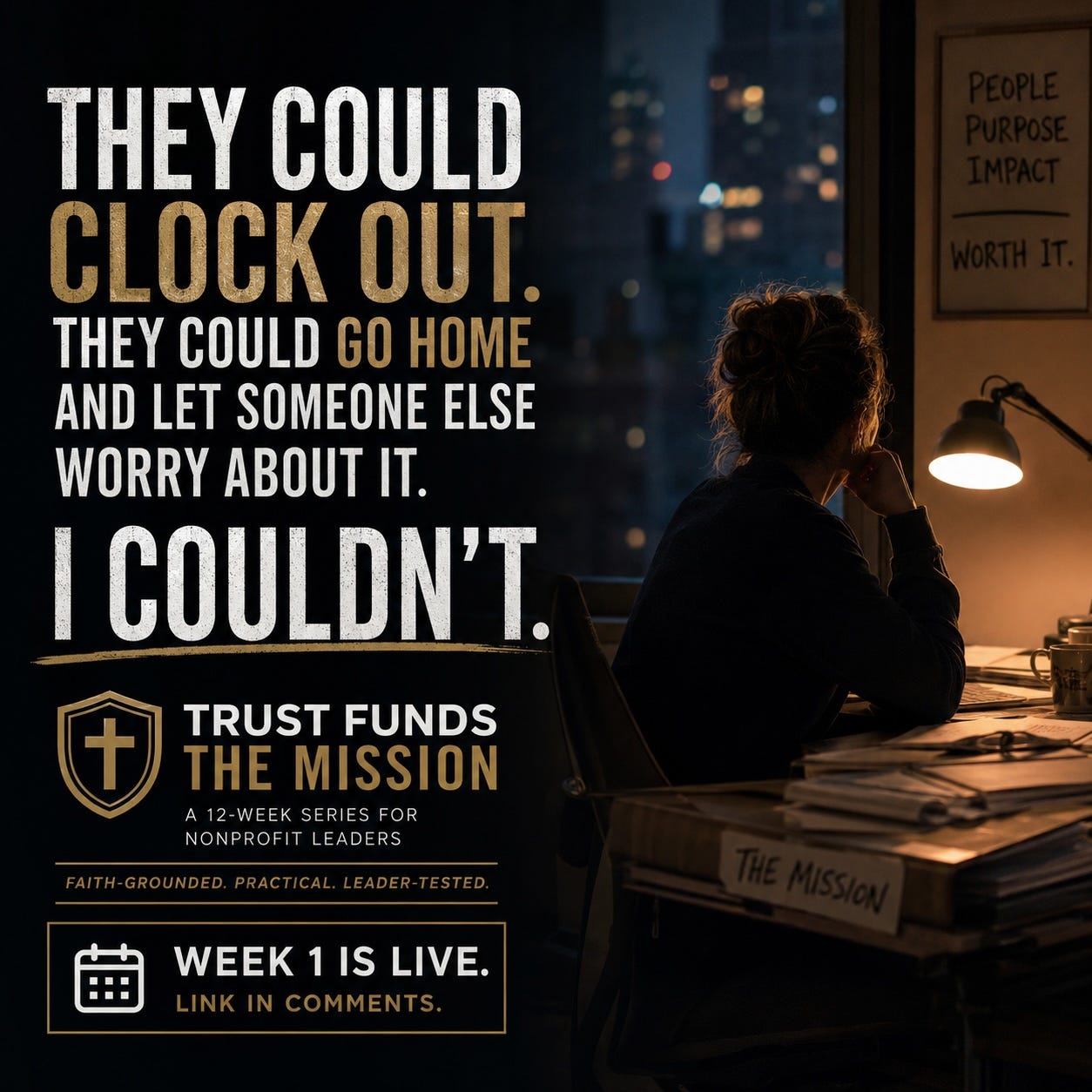
They could clock out. They could go home and let someone else worry about it. I couldn’t. And from that day forward, I didn’t.
That’s the quiet burden. And if you’re leading a nonprofit — especially if you’re leading it faithfully in hard financial seasons — you know exactly what I’m talking about.
It doesn’t show up in your public communications or your latest video. It’s relentless — following you from moments of joy straight back to the same challenge, over and over.
How do I move our mission forward and fund it?
Why This Series Exists
I’ve been in this sector for nearly three decades — as an executive director, VP, consultant, and coach.
I’ve watched underfunded organizations become fully sustained — not because they got better at campaigns, but because their leaders got better at trust.
The quiet burden is one of the most underaddressed leadership realities in the nonprofit world. And it directly affects your fundraising. More than you think.
Over the next twelve weeks, I’m writing a series called Trust Funds the Mission.
I don’t have all the answers. But I’ve fundraised in the middle of a frenzy long enough to know what actually works.
Tactics change. Messaging endures. Mindset determines whether any of it works.
What’s missing is trust. Not the word. The actual thing.
This series is built around a central conviction: fundraising is not primarily about money. It’s about trust. And the leaders who build sustainable support over the long haul aren’t necessarily the most charismatic or polished. They’re the most trusted.
The Job Nobody Described
The particular pain of executive leadership is this: you see all the holes, the ambiguity, and the competing priorities at once.
Other leaders see the need directly in front of them.
You see everything behind it, beside it, and coming around the corner.
That’s not one job. That’s three. And most of you are doing it with fewer resources, less staff support, and more emotional exposure than your peers in the for-profit world would ever imagine.
You feel the tension between mission and money every single week. Asking for funds feels at odds with why you got into this work in the first place. You went into ministry or human services because you wanted to serve people. The development side of the organization sometimes feels like a different world, with its own language.
And then there’s the isolation. Leadership at the top of a nonprofit organization is genuinely lonely in ways that are hard to explain to people who haven’t been there.
You can’t always process the hardest decisions with your team.
You can’t always be fully transparent with your board.
And the donors — as much as you appreciate them — need you to be steady, confident, hopeful.
So you carry a lot of it on your own.
That’s not a weakness. That’s the job.
You can’t give what you don’t have.
Where It Actually Shows Up
When the tank is running low, it shows up directly in your donor relationships — almost never in the ways you’d expect.
It shows up as an extra day before returning a donor’s call.
A thank-you note that never gets written.
A tour postponed, a coffee meeting that keeps getting pushed.
Too often it shows up as a lump in your stomach that quietly says: I don’t have time to call, to thank, or even to pray the way I want to.
Burned-out leaders aren’t sitting around thinking about donor strategy. They’re getting hit in the face by the mission itself — safe shelter, rescued animals, hungry people fed. The urgency of right now crowds out the discipline of relationship-building over time.
And donors don’t know any of that is going on. They don’t see the operational pressure, the staff dynamics, the budget gaps, or the emotional toll.
They only experience what reaches them.
Donors primarily connect when we initiate. When we go quiet — even for understandable reasons — they don’t lean in and ask what’s wrong. They simply drift.
They don’t announce it. They just stop responding. And you rarely find out why.
The Core Framework: Trust Is the Real Currency
Before we get practical, I want to plant a stake in the ground.
Trust is the real currency behind sustainable fundraising.
Not charisma. Not clever campaigns. Not even a great cause — because many great causes are competing for the same donor’s attention.
Trust.
And trust is not built through any single interaction. It’s built the way a bridge is built — piece by piece, over time, through consistent action.
Every time you do what you say you’re going to do, another plank goes down.
Every time you tell the truth about your organization — the wins and the challenges — another plank goes down.
Every time a donor feels seen, heard, and genuinely appreciated, another plank is added.
Donors don’t cross to generosity in one leap. They walk across a bridge you’ve been building, sometimes for years. Your job is to keep building it, faithfully, whether you feel like it or not.
The Only Framework You Need
Step 1 — Name the burden. Get honest about what’s affecting your leadership and your communication right now. Not generally. Specifically. What are you actually carrying, and how is it showing up in your donor relationships? You can’t lead donors somewhere you haven’t been willing to go yourself.
Step 2 — Know your donor. Stop guessing what your donors care about and start finding out. What do they value? What do they worry about? What do they need from you that they’d never think to ask for? The leaders who raise sustainable support aren’t mind readers — they’re listeners. Trust is built on understanding, not assumption.
Step 3 — Tell the story. Facts inform. Stories move people. Every donor relationship needs a narrative thread — a reason to believe that their generosity is connecting to something real. Your job isn’t to report activity. It’s to help donors see themselves in the transformation your mission is producing.
Step 4 — Repeat faithfully. Trust is built slowly. There will be weeks when you make the call and nobody answers. When you write the note and never hear back. When you show up and wonder if any of it matters. It does. Faithful action compounds over time in ways you can’t always measure in the moment. The bridge gets built one plank at a time.
Know yourself. Know your donor. Tell the story. Stay faithful.
That’s the whole game. Simple. Hard. Worth it.
Name Your Own Burden First
Before you can lead donors across a trust bridge, you need to do an honest inventory of your own.
Sit down — not in a meeting, not between tasks — and answer these three questions in writing. Not mentally. In writing.
1. What part of your leadership burden is showing up in your donor relationships right now?
Are you avoiding certain conversations? Letting notes go unwritten? Postponing visits you know you should make?
2. Who in your life actually knows what you’re carrying?
Not your board chair. Not your donors. Someone who can hold the weight with you without needing you to perform for them. If that person doesn’t exist right now, that’s important information.
3. What is one trust-building action you can take with a donor this week?
Not a campaign. Not a system overhaul. One call. One note. One conversation. That’s your starting point.
This isn’t therapy. It’s leadership hygiene. The most trusted leaders I know aren’t the ones who have it all together — they’re the ones who know themselves well enough to keep going when things are hard.
The Picture Worth Holding Onto
Imagine a major donor who’s been with you for eleven years calling you — not because of a campaign, not because of a deadline — to say they’re increasing their gift.
Imagine walking into your year-end push with relationships already warm, rather than a cold list to work through.
Imagine carrying the burden with a little more steadiness because your donors actually feel like partners, not prospects.
That’s what trust-funded mission looks like.
It doesn’t happen because you ran a better campaign. It happens because you showed up, told the truth, and treated donors like partners — not prospects.
The Apostle Paul puts it plainly in 1 Corinthians 4:2: “Now it is required that those who have been given a trust must prove faithful.” That’s stewardship language. That’s the posture of a leader who understands that what’s been entrusted to them — the mission, the resources, the relationships — requires something more than competence. It requires faithfulness.
Faithfulness looks different on different days.
Sometimes it’s a handwritten thank-you note.
Sometimes it’s an honest update to your major donors when a program had a hard quarter.
Sometimes it’s showing up to the gala when you’re exhausted and having a real conversation with someone who’s been giving for twelve years but has never really felt fully seen.
Every one of those moments is a plank in the bridge.
Your Move This Week
The donors you need are already watching. What they’re waiting to see is whether you’ll keep showing up — not perfectly, but faithfully.
Before Thursday, sit down and answer those three questions. Write the honest email. That’s your first plank.
One move. That’s how the bridge gets built.
If this series is hitting something real for you — subscribe.
Dave Sena is the founder of Bold Leading and a nonprofit veteran with nearly thirty years of experience leading, coaching, and consulting faith-based organizations. If you’re stuck, burned out, or just need a clearer path forward — reach out. He’d love to offer prayer, honest feedback, and a roadmap through.


