You Didn't Sign Up to Be a Fundraiser
How ministry leaders learn to fund the work they're called to do
You got into this because of the people
Maybe it was a recovery program that you watched change lives. An after-school ministry that kept kids off the street. A food pantry that you started in a church basement because the need was right in front of you and you couldn’t look away.
You didn’t get into this to write donor emails.
You didn’t feel called to manage a giving database or plan a year-end appeal. You felt called to the work — the real work — the part where something actually changes in a person’s life.
And now here you are, trying to figure out fundraising.
Not because you love it. Because the program you love won’t survive without it.
I want to start there — with that tension — because I think it matters more than most fundraising teachers acknowledge.
You’re not a reluctant fundraiser because you’re failing.
You’re a reluctant fundraiser because your heart is somewhere else, and you haven’t been given a good reason to believe that the way you’re wired is actually an asset, not a liability.
This week I want to give you that reason.
The mistake most program leaders make when they start fundraising
When ministry leaders step into fundraising for the first time, most of them make the same mistake: they try to become someone they’re not.
They watch a polished development professional run a donor event. They see the smooth ask, the cultivated relationships, the practiced storytelling. And they think: I need to learn how to do that. I need to become more like that.
So they build systems. They read books. They set up an email platform and write a newsletter. They create a donor database and a communication calendar. They do everything “right.”
And then they wonder why it still feels hollow. Why donors aren’t responding the way they expected. Why the whole enterprise feels like it’s running — but not alive.
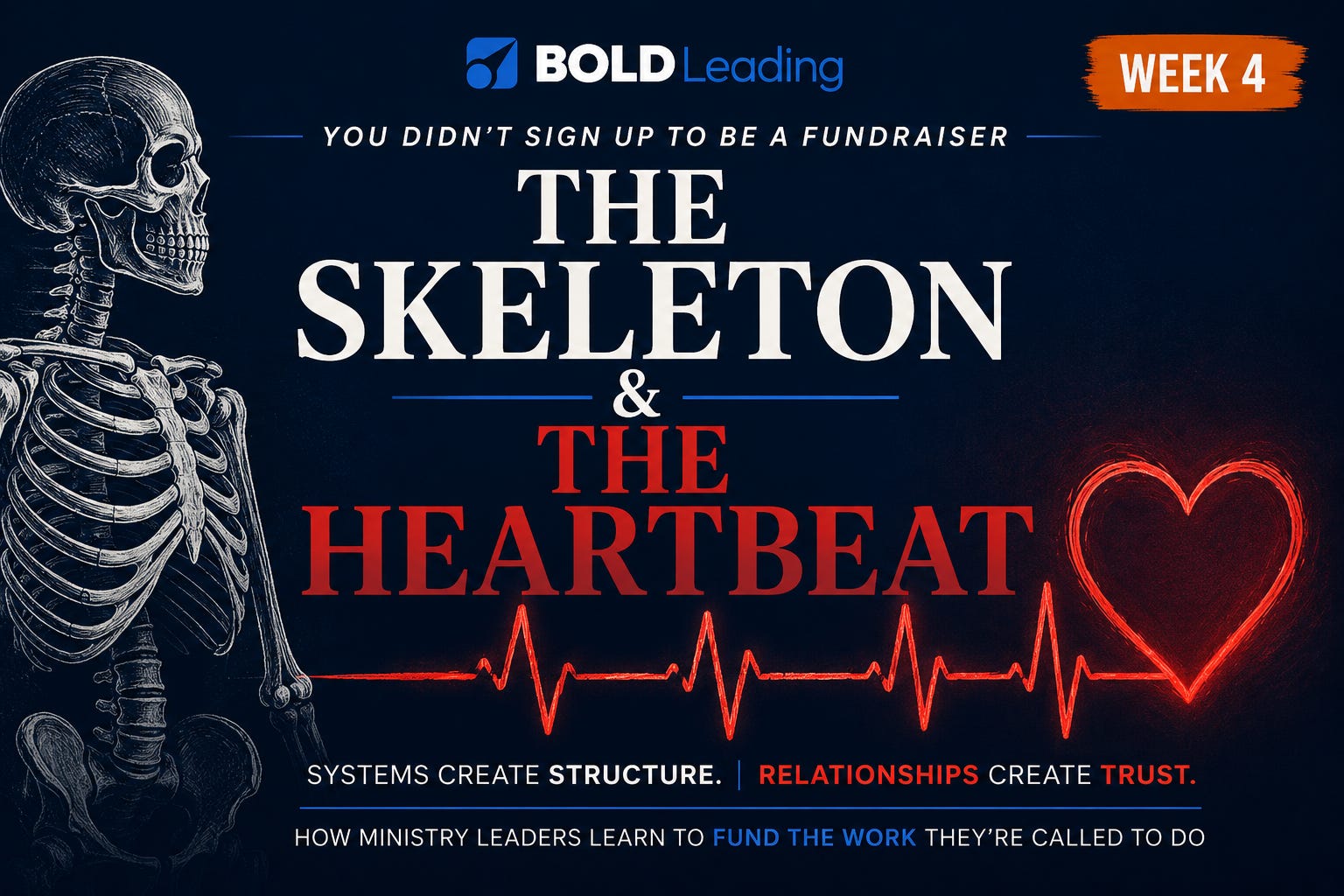
Here’s what’s happening: they built a skeleton without a heartbeat.
Every organization needs a skeleton
Let’s be clear: the systems matter. The skeleton is real and necessary.
A donor who gives and never receives a thank-you doesn’t feel cherished. They feel forgotten. An ask that arrives six months after the last communication doesn’t feel like relationship — it feels like an ambush. Consistent communication, timely acknowledgment, clear impact reporting — these things are not optional. They are the structure that makes trust possible at scale.
You need the skeleton.
But here’s what I want you to understand:
“The skeleton is not what makes donors stay.”
The heartbeat is what you already have
The heartbeat in fundraising is the part that can’t be automated. It’s the specific, human, unrepeatable moments of genuine connection that no system can produce on its own.
And here’s the thing about program leaders: you are already full of heartbeat material.
You know the people your program serves. Not as statistics — as human beings.
You know their names. You know what they were like when they first walked in and what they’re like now. You’ve sat with them in hard moments. You’ve seen the thing your donors are funding actually happen, up close, in real time.
And most program leaders don’t realize they’re carrying it.
“That is the single most powerful asset in fundraising — and it’s already in your hands.”
When a donor hears from someone who runs the program — not a communications staff member, not a form letter, but the actual person who is doing the work — something shifts.
The message isn’t just information. It’s testimony. And donors who receive testimony don’t just stay. They deepen.
What this looks like practically
You don’t have to become a different person to fundraise well. You have to learn to bring the person you already are into the donor relationship.
A few places to start:
Tell a fresh story. You don’t need a library of rehearsed testimonials. You need the fresh story that captures the essence of what your program does — told in your voice, with real detail, from your own experience. Those stories, shared consistently and personally, does more work than a hundred polished appeal letters.
Let donors into what you’re carrying. Program leaders often think donors want to see polish and confidence. What donors actually respond to is honest leadership. Write one honest update a quarter — not about what’s going well, but about what’s hard and why you’re still doing it anyway. This is where trust is built.
Use the skeleton to make room for the heartbeat. Set up the systems — the thank-you process, the communication calendar, the giving acknowledgment — so that they run without requiring your full attention. Then use the time you free up to make personal contact with your top supporters. A phone call. A handwritten note. An invitation to come see the program in person. These moments are what the systems are protecting space for.
Don’t wait until you need something. The donors who stay for decades are the ones who hear from you when you’re not asking for anything. A brief note in April — not tied to any campaign, just sharing something meaningful — is worth more than ten well-crafted appeals. It says: you matter to me even when I don’t need your money.
A word about the discomfort
If asking for money still makes you uncomfortable, it is real and necessary.
The discomfort usually isn’t about the money. It’s the intrusive thoughts that show up the moment you sit down to write an appeal or pick up the phone. The ones that tell you that you’re asking for money for yourself — not for the people you serve. Or that the number feels too big, too much, too bold for someone who got into this to help people, not to ask for things.
Those thoughts feel true. They’re not.
But consider what you’re actually doing when you invite someone to fund your program.
“You’re not begging. You’re not performing. You’re extending an invitation to participate in something that matters.”
The people who give to your program are not doing you a favor. They are becoming part of the work. They are co-laborers in something they couldn’t do alone. And you are the one who gets to offer them that — because you’re the one who built it, who tends it, who believes in it.
“Each of you should give what you have decided in your heart to give, not reluctantly or under compulsion, for God loves a cheerful giver.” — 2 Corinthians 9:7
The cheerfulness on the giving side often starts with the confidence on the asking side. When you believe in what you’re inviting people into, the ask becomes an act of generosity, not desperation.
The systems keep the lights on. The relationships keep people coming back.
“The systems keep the lights on. The relationships keep people coming back.”
Build the skeleton. You need it. But don’t stop there.
Bring the heartbeat — the real you, the one who knows why this program exists and what it costs and what it produces — into your donor relationships. That is the part no consultant can give you. It’s the part you already have.
You didn’t sign up to be a fundraiser. But you signed up for something that requires funding.
And the way you’re wired — close to the work, close to the people, close to the mission — is exactly the foundation that lasting donor trust is built on.
I’d love to hear from you: what’s the hardest part of fundraising for you right now — the systems side, or the relationship side?
Reply and tell me. I read every response.
If this is landing for you, subscribe at blog.boldleading.com for weekly reflections on funding the work you’re called to do.
And if you’re ready to build both the skeleton and the heartbeat in a way that actually fits who you are, let’s talk.
Dave Sena is the founder of Bold Leading, where he works with faith-based nonprofit leaders on the fundraising strategy and donor relationships that sustain meaningful mission work. Subscribe to You Didn’t Sign Up to Be a Fundraiser at blog.boldleading.com.